
There is a small repetitive sequence in the Huntingtin gene. The number of repeats varies between people. When this repetitive sequence has too many extra copies it causes Huntington’s Disease (HD). Most people have 10 – 35 of these repeats. When there are 40 or more it causes HD and is considered to be a mutation. Those who have 36 – 39 copies might go on to develop HD, but if they do, they usually get the disorder at an older age.

Created in https://BioRender.com
Although HD itself is bad for the brain, there is some evidence that people who have more repeats (within the normal range) have larger brains and higher intelligence. There is also some evidence that evolution has been driving the Huntingtin gene to gain more repeats, possibly because it improves brain function. In support of this idea, it has been shown that animals with greater cognition have more repeats.
Considering these findings, a group of scientists from the Iowa State University theorised that maybe the disease-causing versions of the Huntingtin gene are beneficial early in life, even if they come at a cost later. To test this theory, the scientists assessed data from young people with more than 40 repeats, along with their siblings. These young people are part of the Kids-HD study, which is the only study following young people at risk for HD over a long period of time. All the participants were between the ages of 6 and 21, and they either had a parent or grandparent with HD. The researchers took a DNA sample from each of the participants to find out which were going to develop HD. The participants themselves were not told whether they had the short or long form of the Huntingtin gene. In total there were 79 participants with the long form of the Huntingtin gene and 112 young people with short (normal) versions.
One unique aspect of this study was that it calculated the expected age of onset for each person. Those with more repeats in their Huntingtin gene tend to get the disease earlier. By calculating the expected age of onset for each person at risk of HD, the scientists could work out which brain changes were early signs of HD, and which were more likely to be developmental effects. Developmental effects appear very early and may even be present before birth.
The participants were given a series of tests to measure brain function, which showed that in early life, participants with the HD mutation had higher scores for intelligence and movement-related abilities. They also had less psychological problems, such as depression or anxiety. As participants got closer to the expected onset of HD, their scores began to drop until they were below that of participants without the HD mutation. This drop was expected. It had been seen before in those who went on to develop HD. The drop is estimated to begin about 20 years prior to an HD diagnosis, which was confirmed in this study. However, the enhancement in brain function prior to the drop was a new finding.
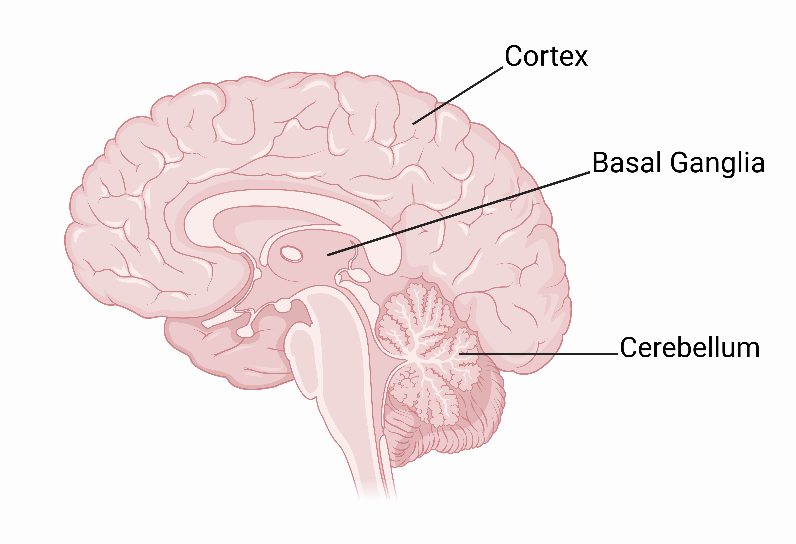
Next, brain scans were done to see how big the brain and some of its main components were. The components included the cortex, which is the outside layer of the brain. Components of the basal ganglia were also measured. One of the components of the basal ganglia, the striatum, is the main part of the brain affected by HD. The size of the cerebellum, which helps the basal ganglia coordinate movement, was also measured. They then looked at how many folds there were in the cortex and the size of the folds. More folds mean more brain cells, which is why humans have much more wrinkly-looking brains than other animals.
Created in https://BioRender.com
Interestingly, there were early enhancements in brain size and folding, but these were only seen in the cortex, which is the part of the brain that got much larger in humans as we evolved. No difference was seen at young ages in the basal ganglia. The basal ganglia has only gotten slightly larger over our evolutionary history, and this is probably only to support all the extra inputs from the cortex. Given that it is the basal ganglia that suffers the most in HD, it appears that HD-causing mutations may enhance the cortex at the expense of the basal ganglia.
Lastly, the measures of brain size and folding were compared to the test scores for each person. This showed that those with bigger brains had higher cognition. This last piece is important, because a bigger brain is not always better. Having a larger brain has been associated with developmental disorders. However, in this case, it appears to be a positive thing.
This study has the potential to significantly alter our thinking around treatment plans. Until now the assumption has been that the mutant form of HD is only toxic, which is why therapies are being developed to switch it off. However, if the longer forms of the gene offer advantages early in life, it might be better to focus on altering the gene’s function at the point where it starts to become harmful, which is about 20 years prior to the onset of HD. This might leave the brain enhancements intact while mitigating the serious long-term consequences.
Although we usually summarise research produced in New Zealand, this article from Iowa State University in the United States of America stood out as particularly relevant and interesting. Importantly, it shows the benefits of research with young people who are presymptomatic. This study has the potential to profoundly change how we think about Huntington’s Disease, and perhaps other brain disorders as well.
Neema, M., Schultz, J. L., Langbehn, D. R., Conrad, A. L., Epping, E. A., Magnotta, V. A., & Nopoulos, P. C. (2024). Mutant Huntingtin Drives Development of an Advantageous Brain Early in Life: Evidence in Support of Antagonistic Pleiotropy. Annals of neurology, 96(5), 1006-1019.